Off-The-Shelf Intranet vs. Custom Platforms: How to Choose the Right Intranet Software
Compare intranet software options, including off-the-shelf tools and custom platforms, and learn how to choose the right fit for your employees.

This blog was originally published in 2017 but has been updated in 2026 for accuracy and comprehensiveness.
Learn how to build the right intranet for your company.
There are dozens of intranet software options available for companies, and choosing the right one can be a challenge, especially for those who are launching an intranet for the first time. Any selection process should start with a comprehensive understanding of what your employees need. Are they looking for a better way to collaborate online? Are they just tired of logging into three different sites to manage their work schedules? Taking the time to assess these pain points will help you create a list of priorities to guide your decision.
However, once you gather your requirements, you’re still left with a crowded market of intranet solutions. Most software will fall into one of three categories, and narrowing your options down to one of these will streamline the decision-making process.
Key Takeaways
- Intranet software can take different forms, including a suite of existing workplace tools, an off-the-shelf intranet solution, or a custom platform.
- The right intranet software should reflect employee needs, business goals, internal resources, and long-term flexibility requirements.
- Off-the-shelf intranet tools may be faster to deploy, but they can limit customization as organizational needs become more complex.
- Custom intranet platforms can better support unique workflows, complex operations, and deeper integrations with existing business systems.
Why Is Choosing the Right Intranet Software Important?
Choosing the right intranet software affects how employees communicate, access information, complete tasks, and stay connected to the organization. Whether your team is considering an off-the-shelf intranet, a custom platform, or a suite of existing tools, the wrong solution can create more friction by scattering resources across too many systems, making content harder to manage, or limiting the flexibility teams need as the business grows. The right solution, on the other hand, can help create a more useful digital workplace that supports employees instead of slowing them down.
It shapes the employee experience
Intranet software plays a major role in how employees interact with internal information and workplace tools. A solution that is easy to navigate, searchable, and personalized can help employees find what they need faster and feel more connected to the organization.
It affects productivity and collaboration
When employees have to jump between disconnected systems or search through outdated content, routine tasks take longer than they should. The right intranet software can centralize important resources, support collaboration, and reduce the friction that gets in the way of daily work.
It Influences Long-Term Flexibility
A company’s intranet needs can change as teams grow, workflows evolve, and new systems are introduced. Choosing flexible intranet software makes it easier to adapt the experience over time, add new capabilities, and support changing employee needs without starting from scratch.
What Are the Different Types of Intranet?
Organizations have several options when choosing how to build or modernize an intranet. Some rely on a suite of existing workplace tools, while others choose an off-the-shelf intranet solution or invest in a custom platform built around more specific employee and business needs. The right choice depends on your company’s goals, internal resources, employee expectations, and how much flexibility you need as the organization grows.
1. The Suite of Tools
If you don’t have an intranet yet, your team is likely already working with their own preferred set of online tools and apps. This could include storing meeting notes on Evernote, scheduling with Doodle polls, sending big files with WeTransfer or using other productivity apps.
For companies that don’t need a fleshed-out intranet solution, encouraging employees to use a standardized suite of tools is a great alternative to an intranet. This approach only requires you to choose the tools you want employees to use and ensure everyone has the access they need.
Many online work tools are able to integrate with one another these days, and assembling a suite of tools that fit your team’s needs is easier to achieve than managing an intranet — provided your team doesn’t use more than a dozen tools or doesn't have conflicting requirements. But what if things are a little more complicated than that?
2. The Off-the-Shelf Solution
Off-the-shelf intranet software is best for companies that have general needs. That is, their requirements are more complicated than a suite of integrated tools can handle, but not so complicated that they need custom development. In this scenario, an intranet solution that comes with standard features out-of-the-box is a great fit.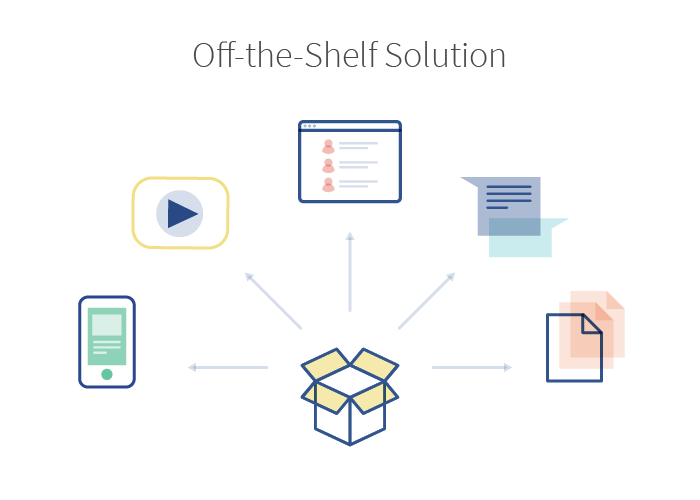
Some of the typical features available in an off-the-shelf intranet solution are:
- Personalized homepages and newsfeeds
- Video player capabilities
- Document libraries
- Activity streams
- Group pages
- Employee profiles and blogs
- Mobile-enabled
Off-the-shelf solutions are useful for companies that are short on time, budget or development resources. Launching an intranet is one thing, but maintaining it is another. You can keep an off-the-shelf solution updated with less resources, though you run the risk of being more dependent on the vendor and whatever future decisions they make about different features.
Additionally, an off-the-shelf solution will have already made a lot of decisions for you, by requiring you to take certain aspects as-is, without any opportunity to customize. This can be a really good thing, especially if your company is new to user experience (UX) design. Imagine building your own internal version of Facebook from the ground up. Are you ready to make all of the UX decisions that go into designing a social platform? Using out-of-the-box tools for a social intranet will ensure that you are rolling out a site with a strong user experience foundation, without too much investment. From there, you can always continue to tweak according to your needs.
3. The Custom Platform
The final category of intranet software is the custom platform. This is a web platform solution for large enterprises that have complex needs. Often, these are industry-specific, such as a retail bank that needs to incorporate finance-specific tools that its employees use daily. Custom platforms are always a commitment, but there are many things they do well that off-the-shelf solutions can’t accomplish.
How to Choose the Best Intranet for Your Business
Choosing the right intranet software is a strategic decision that requires a thorough evaluation of your current and future needs. Follow these steps to frame your decision.
1. Define the main purpose of your intranet
Clarify whether the intranet is primarily for announcements, knowledge management, employee self-service, or a broader digital workplace experience.
2. Map employee needs by role and department
Evaluate how different teams use information. Marketers may need campaign management capabilities, while the sales team may prioritize product knowledge access. IT leaders may prioritize identity management and security.
3. Review your integration requirements
Identify which systems the intranet needs to connect with, such as HR platforms, CRM systems, or existing tools like Google Workspace. More complex needs may push you toward a custom or platform-based approach.
4. Evaluate internal technical resources
Determine if your business has the technical expertise and budget to maintain a custom intranet after the initial launch.
5. Calculate total cost of ownership
Look beyond the upfront cost. Compare licensing fees against implementation, customization, maintenance, and the potential cost of switching platforms later.
6. Think beyond the initial launch
Consider future scalability, multilingual needs, and whether you need to support frontline employees with mobile access or an employee app.
Benefits of off-the-shelf intranet and custom platforms
Both off-the-shelf and custom intranet platfoms can significantly improve employee engagement rates and team communications, but they solve different types of problems. Your choice should be based on whether you prioritize speed and simplicity or control and deep integration.
Benefits of off-the-shelf intranet solutions
- Faster implementation. Using prebuilt templates and standard features allows you to connect employees much sooner than a custom-developed project.
- Lower initial complexity. Much of the technical burden is shifted to the vendor, reducing the immediate workload for your internal IT team.
- Built-in best practices. These platforms often incorporate proven patterns for navigation, document sharing, and internal comms, which can help guide your strategy.
- Predictable feature set. Predefined functionality makes it easier for stakeholders to understand what the intranet can do before committing to a rollout.
- Easier vendor support. Most solutions include documentation, updates, and customer support resources to help with implementation and troubleshooting.
Benefits of custom-made intranet solutions
- Greater control over employee experience. You can design a user-friendly intranet interface around the actual behaviors of your frontline employees and remote and distributed teams.
- Support for complex workflows. Custom development can support specific task management, approval processes, and digital forms tailored to your operations.
- Stronger integration potential. These intranets can serve as a "single pane of glass" by pulling data from multiple channels into a unified user interface.
- Relevant personalization. You can tailor tools and news feeds by role, location, or department. Liferay DXP's intranet solution, for example, allows you to dynamically change layouts based on user attributes and behavior.
- Advanced recognition and culture tools: Custom solutions make it easier to integrate peer recognition and employee recognition features that align with your specific company values.
Drawbacks of off-the-shelf intranet and custom platforms
No intranet strategy is perfect, and every choice involves a unique set of trade-offs. By proactively identifying the potential pitfalls of each model, you can stay ahead of the curve and prepare your team for the challenges ahead.
Drawbacks of off-the-shelf intranet solutions
- Limited customization. Businesses may be restricted by predefined templates, workflows, or user experience options that don't fit their culture.
- Potential fit gaps. Standard features may not fully support unique business processes, compliance requirements, or specific content models.
- Integration limitations. Some platforms may not integrate deeply enough with the existing tools your employees use every day, such as specialized CRM or ERP systems.
- Vendor dependency. You depend on the vendor’s release schedule and pricing model. If they change their "user month" pricing, your costs could shift unexpectedly.
- Scalability concerns. A solution that works for today’s needs may become restrictive as the business adds more departments or digital workplace requirements.
Drawbacks of custom-made intranet solutions
- Higher upfront investment. Custom design, development, testing, and integrations make custom intranets more expensive to launch.
- Longer implementation timeline. Gathering and validating requirements takes time, which may delay the delivery of the new platform to your employees.
- Greater dependence on technical resources. You will need ongoing access to developers to maintain and improve the platform over time.
- Maintenance and governance requirements. Custom intranets require clear ownership for security, content governance, and performance.
- Risk of overbuilding. Organizations can spend time and budget building advanced features that employees do not actually use unless decisions are anchored in user research.
Examples of Custom Intranet Platforms in Practice
Custom intranet platforms can give organizations more control over how employees access information, complete tasks, and interact with internal systems. Unlike more standardized approaches, intranets built on custom platforms are better equipped to handle complex and unique business needs. The following examples show how organizations have used custom intranet platforms to support specific operational goals and improve the employee experience.
Domino’s
As a global brand and world leader in pizza delivery, Domino’s struggled to communicate with their franchise and corporate team members. They needed a site that allowed for more customization and created a more user-specific experience. Using a custom solution, Domino’s was able to create different categories with granular permissions — which in turn provides corporate and franchise team members a custom experience with content relevant to the user, their location and store type. These permissions are also critical for allowing Domino’s to share confidential information securely, which is an important feature given their franchise model. In addition to this, the Domino’s team built a one-stop-shop with news updates, customizable dashboards and a subscription-based news tool to make their intranet, dLive, a great place to receive user-specific information. Traffic has increased from 8,000 visits per week to 20,000 per week on the updated site.
Custom platforms also have greater flexibility than other intranet software options. Your intranet should be an extension of your company culture, and a customizable platform allows you to align internal culture initiatives with the first thing your employees see on the homepage.
Domino’s custom platform also enabled them to add a social sharing tool called DPZ Social for corporate and franchise team members to share photos and posts like they would on social media, helping tie their different global offices into the greater Domino’s culture. The possibilities are numerous for companies that have the resources to invest in great experiences for their employees.
QAD
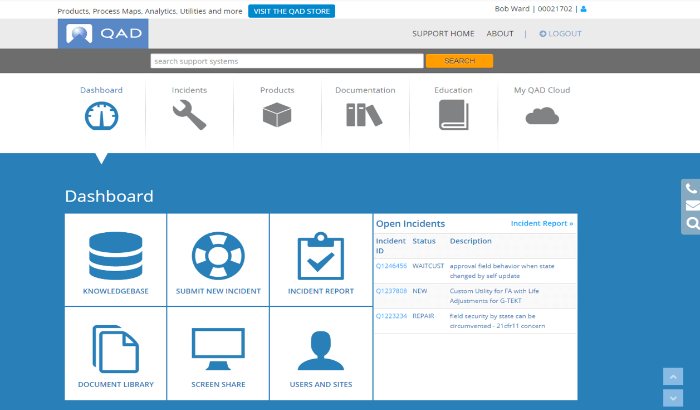
Increased flexibility is also critical for organizations that have changing requirements that need to be quickly accommodated. QAD, a provider of manufacturing ERP software, has to include new business requirements with every project they launch within their intranet. Because the IT team has invested in its customized intranet, it is able to quickly accommodate these new requirements every time they come up, and provide a unique work tool for the employees it supports.
Finally, if your company is planning to incorporate new technologies like AI or IoT into your intranet, a custom platform will allow you to plan for how you’ll bring those into your infrastructure. Integration with an off-the-shelf solution will depend on when the vendor decides it is worth the cost to enable these technologies. Building with customizable intranet software will put that much more power in your company’s hands.
Start With What You Need
Whether you’re building an intranet for the first time or updating a long-standing site, it’s best to start with what you know you need. Often, the true challenges for intranets are in convincing your employees to actually use them. By focusing on the applications and tools you know they use on a daily basis, you can choose intranet software that will address their core pain points, ensuring better employee engagement across the board.
How Mature is Your Intranet Solution?
Regardless of what tools you use to build your intranet, there are varying stages of maturity distinguished by the range on functionality and its focus on employee experience and engagement. Assess where your intranet stands.
Why Liferay DXP Is a Strong Choice for Modern Intranets
Liferay DXP is a strong fit for organizations that want the structure and speed of a modern intranet platform without sacrificing the flexibility needed for custom employee experiences.
- Balance speed and flexibility. Launch with platform-based capabilities, then extend them over time with extensive customization as your strategy matures.
- Personalize at scale. Tailor layouts, news, and tools based on role, location, and behavior without creating separate sites for every team.
- Connect existing systems. Rather than creating another siloed application, use Liferay DXP to bridge your existing enterprise tools into one cohesive experience where data flows seamlessly.
- Enterprise-ready governance. Support consistent internal communication with robust publishing workflows and advanced permissions.
- Low-code efficiency. Use low-code and reusable capabilities to adapt the experience quickly, reducing overreliance on technical knowledge for every update.
Liferay DXP is a powerful choice for organizations that need a modern intranet platform with room for personalization, integration, and long-term growth.
Choosing the Right Intranet Strategy for Long-Term Success
Choosing between an off-the-shelf intranet and a custom solution is a pivotal moment for your company culture. While off-the-shelf options prioritize speed, custom builds offer the tailored control necessary for complex operations.
By focusing on your specific integration requirements and the needs of your frontline workers and remote teams, you can build a platform that improves productivity for years to come. Liferay DXP helps you create an intranet that is easier to manage, more relevant to employees, and more adaptable over time.
Explore how Liferay DXP can help you build a modern intranet that connects your workforce and scales with your business.
Frequently-Asked Questions
What is the difference between an off-the-shelf intranet and a custom intranet?
An off-the-shelf intranet comes with prebuilt features and templates, whereas a custom intranet is designed around an organization’s specific workflows and employee needs.
Can an off-the-shelf intranet be customized?
Most offer basic configuration for branding, content management, and permissions, but they may not support the extensive customization required for complex department workflows or unique digital forms.
Is an off-the-shelf intranet better than a custom intranet?
Neither is objectively better. Off-the-shelf is often preferred for speed and simplicity, while custom solutions are better for organizations with complex requirements and deep system integrations.
When should a business choose a custom intranet?
Consider a custom approach if you have multiple employee groups with diverse needs, a requirement for deep system integration, or strict compliance standards.